
Case Study:
When the World Came Back to Atlanta
Thirty years after the Centennial Olympic Games, FIFA World Cup 2026 gave Atlanta another opportunity to welcome the world.
For Green Media Works, it was a chance to help tell a story we’ve been working on with Atlanta Convention & Visitors Bureau for more than 20 years.
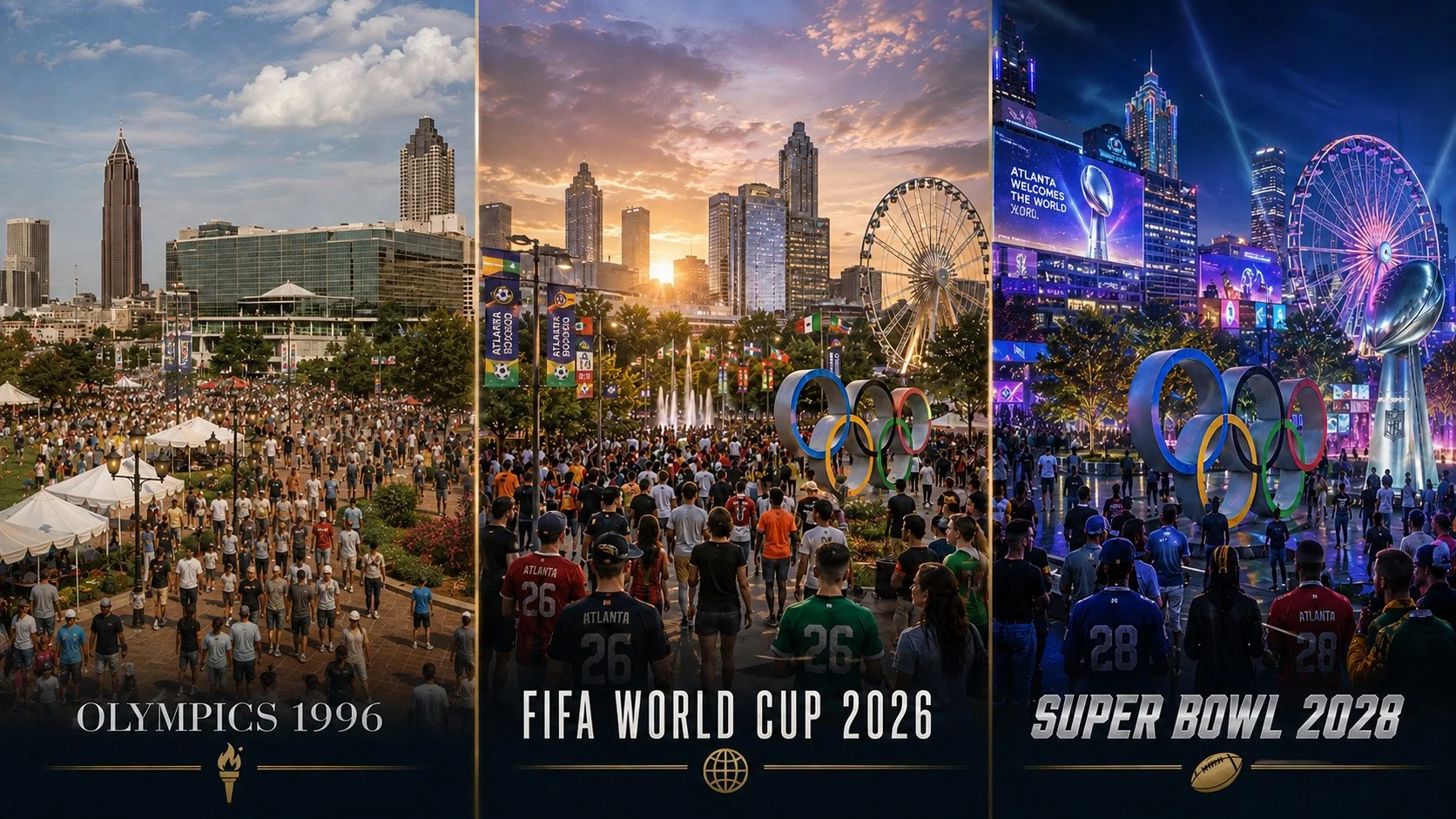
In 1996, Atlanta had something to prove.
The Summer Olympic Games introduced a rapidly changing Southern city to a global audience. Atlanta demonstrated that it could host the world, and the Games left behind more than venues and Centennial Olympic Park. They helped establish Atlanta as an international destination.
Thirty years later, the world came back.
But Atlanta was different.
By the time FIFA World Cup 2026 arrived, the city no longer needed to convince people that it belonged on the world stage. Atlanta had hosted Super Bowls, Final Fours, championship games, conventions and some of the largest entertainment events in the country.
This time, the opportunity was more personal:
Show the world who Atlanta really is.
A more relatable Atlanta
That has been an important part of Atlanta Convention & Visitors Bureau’s work for years.
Atlanta’s story is bigger than a skyline, an airport or a list of attractions. It’s music. Food. Sports. Civil rights. Neighborhoods. Creativity. Black culture. Southern hospitality. International communities. And, most importantly, people.
Green Media Works has had the privilege of working with ACVB for more than two decades as that story has evolved.
We’ve created destination films, presentations, event experiences and visual communications designed not simply to promote Atlanta, but to make the city feel approachable.
World Cup gave that effort an extraordinary new audience.
And one of our favorite projects was also one of the simplest ideas:
Let Atlanta welcome them.
Welcome to Atlanta
For ACVB’s FIFA World Cup welcome film, Green Media Works brought together recognizable Atlantans from sports, music, entertainment, business and civic life.
Instead of another tourism montage telling visitors how great Atlanta is, the people who help define Atlanta looked directly into the camera and welcomed them.
That distinction mattered.
The personalities represented different generations and different sides of the city, but together they communicated something much larger: Atlanta is confident enough to be itself.
That was exactly the tone we wanted.
The production connected the global scale of the World Cup with something much more human. Before visitors found a restaurant, attended a match or explored a neighborhood, Atlanta was simply saying:
We’re glad you’re here.
Extending the welcome beyond the screen
The film introduced Atlanta.
Discover Hubs helped continue the conversation once visitors arrived.
During the World Cup period, Discover Hubs operated across convention, sports, downtown, hotel, cultural and visitor environments throughout metro Atlanta. The full network included 20 Hubs across seven deployment areas.
But some of the most important placements were concentrated right in the middle of Atlanta’s World Cup activity.
Seven Hubs operated throughout Georgia World Congress Center convention and visitor corridors, with two more incorporated into ACVB’s Georgia The Whole Day Through experience. Three additional Hubs operated nearby at Peachtree Center.
That put Discover Hubs inside a downtown district filled with international visitors moving between hotels, Georgia World Congress Center, Mercedes-Benz Stadium, restaurants, attractions and FIFA Fan Festival at Centennial Olympic Park.
The numbers give some sense of the scale.
ACVB’s Georgia The Whole Day Through experience welcomed 70,000 visitors, while reported attendance at FIFA Fan Festival exceeded 500,000 during the tournament.
We don’t claim that every one of those people saw a Discover Hub.
In fact, we deliberately chose not to.
Our post-event analysis estimated 510,000 to 760,000+ opportunities to view Discover Hubs content, using conservative assumptions about visitor traffic and exposure. Where reliable World Cup-specific traffic information wasn’t available—including Peachtree Center—we left it out rather than inflate the result.
For us, the more important result was what the network could do with that visibility.

From broadcasting Atlanta to continuing the conversation
This may be one of the biggest differences between Atlanta’s global moment in 1996 and the one we experienced in 2026.
Thirty years ago, the primary challenge was introducing Atlanta to the world.
Today, destination communication can continue after someone gets off the plane.
A film can create an emotional welcome.
A campaign can build anticipation.
A physical network like Discover Hubs can carry that message into the places visitors actually move through—and then adjust the conversation according to where they are, what is happening and what they may want to do next.
For Green Media Works, the Welcome to Atlanta film and Discover Hubs were two very different projects serving the same idea.
Make Atlanta feel welcoming before the visitor arrives—and useful once they get here.
Thirty years later
There was something fitting about seeing Centennial Olympic Park filled with international fans again.
The park was created as a gathering place for the world in 1996. Thirty years later, it became one again.
But the Atlanta surrounding it had grown into a much more confident destination.
Mercedes-Benz Stadium. A transformed convention district. Atlanta BeltLine. A globally recognized food and music culture. Thriving neighborhoods. One of the strongest soccer cultures in the United States. And a hospitality community with decades of experience welcoming major events.
Atlanta didn’t need to reinvent itself for World Cup.
It needed to let people experience it.
We’re proud Green Media Works could play a small part in making that happen.
And the next welcome is already coming
World Cup wasn’t an ending.
It was another step in Atlanta’s evolution as one of America’s great host cities.
Super Bowl LXII comes to Mercedes-Benz Stadium in 2028, bringing another enormous national and international audience to Atlanta.
And the lessons from World Cup will travel with us.
Better location-based communication. More responsive visitor information. Stronger connections between destination storytelling and the physical guest experience. More opportunities to make a very big city feel personal.
Thirty years after the Centennial Olympic Games, World Cup showed how much Atlanta has changed.
It also reminded us of something that hasn’t.
Atlanta still knows how to welcome people and the Spirit of Atlanta is alive and well and welcoming guests better than ever.
Our job is to keep finding better ways to help it do that.
Useful while it still mattered
A major event rarely goes exactly according to plan.
Weather changes. Outdoor activities close. Viewing areas reach capacity. Visitors suddenly need another option.
That was where Discover Hubs became much more interesting than a network of digital signs.
During World Cup, approved visitor messages could be updated across active locations in approximately 10 minutes. When weather affected plans, Fan Festival conditions changed or a viewing location reached capacity, the network could replace outdated information with current guidance and point visitors toward alternative watch parties, maps and destinations.
At least four significant real-time communication events were supported during the activation, alongside approximately 60 World Cup match graphics and ongoing content covering dining, attractions, transportation, neighborhoods, events and QR-enabled calls to action.
That ability changed the role of the Hub.
A visitor walking through the convention district didn’t necessarily need another advertisement.
They might need to know where to watch the next match.
Where to eat.
Whether an outdoor event was still happening.
Or what else they could discover nearby.
The job of the Hub was to be useful at that moment.
That is the direction we believe destination communication is headed.
